
Tree Root Investigation & Mapping Penrith
AQF Level 5 Consulting Arborists, Non-Destructive Root Investigation and Development Support
Need to determine where tree roots are located before construction or excavation begins?
Penrith Tree Permit Services provides Tree Root Investigation and Mapping throughout the Penrith Local Government Area, using non-destructive investigation techniques to identify the location, size and depth of important tree roots while minimising unnecessary damage.
Above-ground assessment can identify likely root-zone constraints, but it cannot always confirm the actual location, size or depth of individual roots.
Where greater certainty is needed, for buildings, footings, driveways, swimming pools, retaining walls, services or excavation within or near a Tree Protection Zone, direct investigation provides site-specific evidence that can help architects, engineers and arborists consider appropriate design or construction responses and reduce the risk of significant roots being unexpectedly encountered once construction is underway.
Wherever practicable, the same AQF Level 5 Consulting Arborist who prepares the Development Arborist Report or Arboricultural Impact Assessment undertakes the root investigation, providing continuity of arboricultural advice throughout the project.
Identify ConflictInvestigate RootsMap FindingsAssess ImpactInform DesignReport
AQF Level 5 Consulting Arborists32+ Years’ ExperienceNon-Destructive Investigation
When Is Tree Root Investigation Useful?
Tree Root Investigation is particularly useful where proposed development or construction occurs within or near a Tree Protection Zone and actual root information is needed to assess the potential impact.
This can include:
- Building footprints or additions close to retained trees
- Proposed footings within or near Tree Protection Zones
- Driveways, vehicle access and swimming pools
- Retaining walls and excavation
- Underground services and drainage infrastructure
- Construction close to neighbouring trees
- Development design where tree retention is proposed
- Situations where roots are unexpectedly encountered during construction
Investigation may occur during planning and design, as part of Development Application assessment, or during construction where additional root information becomes necessary. The appropriate scope depends on the tree, proposed works, site conditions and the information required to make an informed arboricultural or design decision.
A calculated Tree Protection Zone identifies an area where development impacts need to be considered, but it does not show the exact location of every individual root.
Where proposed work conflicts with a retained tree, direct investigation can provide greater certainty about the roots actually occurring within the affected area, informing decisions such as building location, footing design, excavation methods, driveway alignment, service relocation or other tree-sensitive design options.
Root investigation does not guarantee that development within a Tree Protection Zone will be acceptable or that a tree can always be retained. It provides additional site-specific evidence to inform that assessment.
Our Tree Root Investigation Process
Identify the potential conflict
We review the proposed development or construction activity, relevant plans and the relationship between the works and retained trees to establish where direct root information may assist the assessment.
Investigate
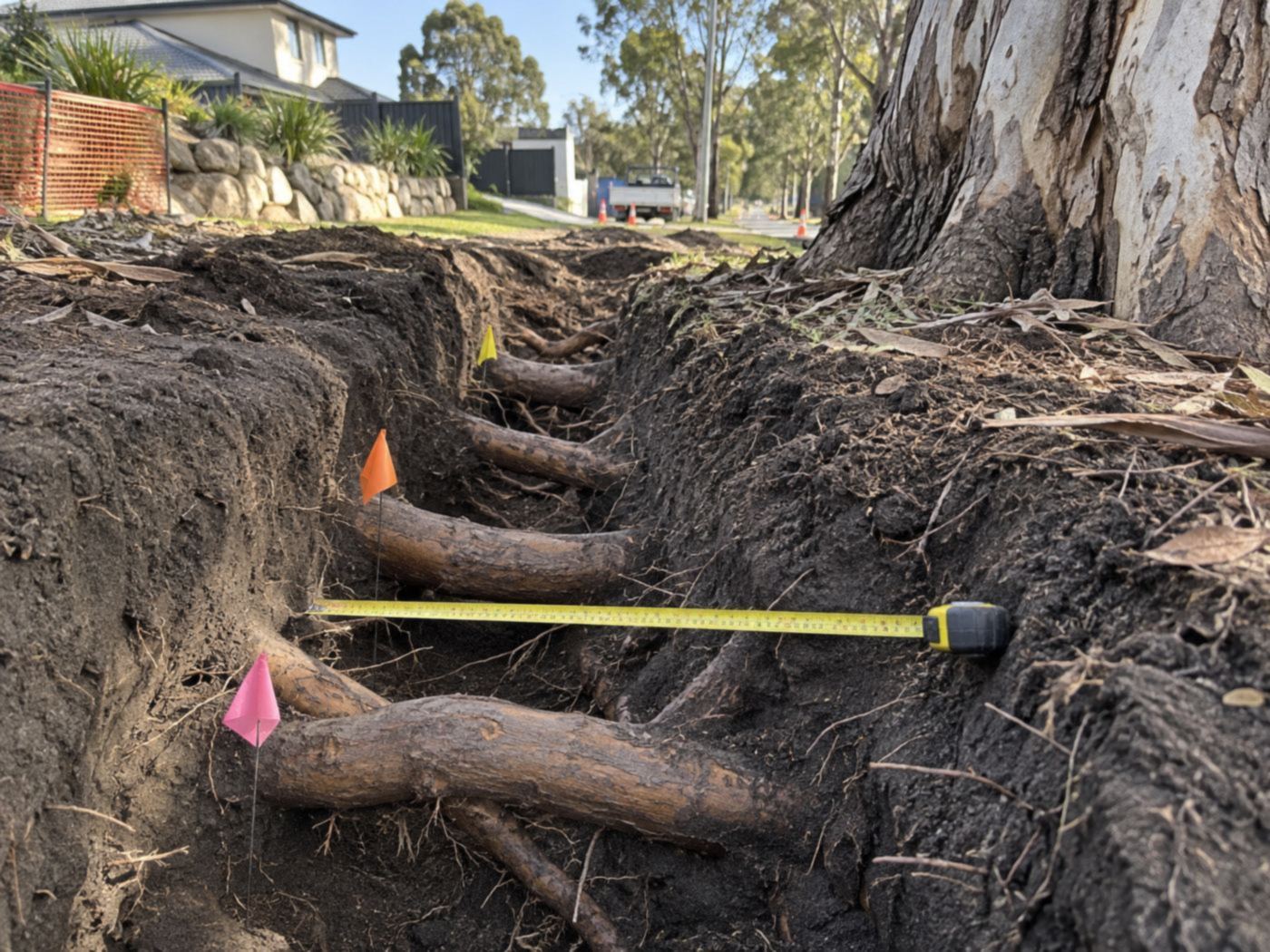
Non-destructive excavation methods are used where appropriate to expose roots while minimising unnecessary damage. The location and extent of investigation depend on the proposed work and the information required.
Record and map
Roots encountered are assessed and documented, covering location, diameter, depth, orientation, distribution, structural root information, trench location and photographic evidence, depending on the project.
Assess the impact
The findings are considered against the proposed works, Tree Protection Zone, Structural Root Zone and the condition and retention of the tree.
Inform design
Where appropriate, findings can assist architects, engineers and other project professionals in considering design or construction changes.
Report
Investigation findings and arboricultural recommendations are documented where required for the Development Application, project team, Council or construction process.
What Does a Root Mapping Report Document?
Penrith City Council’s Development Control Plan Part C2, Vegetation Management, provides that an Arborist Report supporting a Development Application may need to address matters including the age, health and condition of trees, the condition of the root zone and the impact of proposed works on trees and vegetation.
Where direct root evidence is needed to properly address these matters, our root mapping reports typically document:
- A scaled plan showing the investigation or trench location relative to the subject tree and nearby structures
- Tree Protection Zone and Structural Root Zone information
- Trench orientation, length, depth and any site constraints encountered
- Photographs of the investigation area and roots encountered
- Location, size and orientation of significant roots
- Assessment of the proposed development impact, with arboricultural recommendations and mitigation or tree-sensitive design considerations where relevant
Where greater certainty is required about roots within a proposed work area, direct investigation can provide site-specific evidence rather than relying solely on calculated protection zones and above-ground assessment.
Findings can feed directly into Arboricultural Impact Assessments, TPZ and SRZ impact assessment, footing and engineering design, construction methodology, Tree Protection Plans, excavation planning and service installation.
Obtained early, they can be incorporated into architectural and engineering decisions before construction begins, reducing unexpected root conflicts, redesign and avoidable delays later in the project.
Council information last verified: 30 August 2026. Council requirements can change. This page provides general guidance current as of the date above. For a determination specific to your property, confirm current requirements with Penrith City Council or arrange a site assessment.
Root Investigation During Construction
Root investigation is not limited to the Development Application stage.
During construction, excavation or site works may encounter roots that were not previously exposed, or the approved documentation may require further arboricultural assessment.
In these circumstances, the Project Arborist may need to assess the roots and surrounding construction activity, establishing root location, size and depth, the relationship to proposed excavation, potential impact on the retained tree, and whether construction methodology or further arboricultural recommendations are needed, before work proceeds.
Where the Development Consent requires Project Arborist supervision, the findings can also form part of construction-stage compliance documentation.
Non-destructive investigation
Where appropriate, investigation uses non-destructive excavation techniques including air excavation, careful root exposure, measurement, mapping and photographic documentation, to obtain useful site-specific evidence without the damage conventional excavation may cause.
The methodology and extent depend on the site, tree, proposed works and purpose of the assessment, undertaken with regard to the current applicable edition of AS 4970, Protection of Trees on Development Sites.
Development Projects We Support
Residential Development
New homes, knockdown rebuilds, duplexes, multi-dwelling developments, subdivisions, swimming pools and other residential works close to retained trees.
Commercial & Industrial Development
Commercial buildings, warehouses, industrial facilities and mixed-use developments where excavation, structures or services interact with Tree Protection Zones.
Community & Infrastructure Projects
Schools, childcare centres, community facilities, roads and infrastructure where root location may affect design or construction.
Rural & Growth-Area Development
Subdivisions, larger development sites, growth-area projects and infrastructure or service corridors where retained trees interact with proposed works.
We work with architects, structural and civil engineers, builders, developers, Principal Certifiers, surveyors, town planners, landscape architects and utility contractors to integrate root evidence into development design and construction planning.
Where significant roots are identified within a proposed work area, early communication between the arborist and project team can help determine whether practical design or construction alternatives should be considered.
Tree Root Investigation Throughout the Penrith LGA
AQF Level 5 Tree Root Investigation and Mapping is available throughout Penrith’s North, South and East Wards for residential, commercial, industrial, infrastructure, rural and growth-area developments.
Root investigations can assist where buildings, footings, driveways, retaining walls, swimming pools, services or excavation conflict with retained or neighbouring trees and greater certainty about actual root location is required.
Relevant Penrith Tree Root Investigation Case Studies
Real root investigations provide useful examples of how direct evidence can influence tree assessment, design and construction decisions.
Our Penrith root investigation case studies cover relevant matters such as:
- Root mapping before building design
- Excavation near retained trees, footings, driveways and retaining walls
- Swimming pool development and underground service installation
- Air excavation and root exposure
- Root investigation supporting tree retention
- Design changes following root investigation
- Roots encountered during construction
Why Choose Penrith Tree Permit Services?
AQF Level 5 Consulting Arborists
Professional root investigation, arboricultural assessment and Council-ready reporting.
Evidence Before Excavation
Where root location matters to development or construction, direct investigation can provide site-specific evidence before potentially damaging excavation proceeds.
Non-Destructive Investigation
Air excavation and careful root-exposure techniques used where appropriate to minimise unnecessary root damage.
32+ Years’ Arboricultural Experience
Practical experience across tree assessment, development impacts, roots and tree protection.
Development Specialists
Root evidence prepared to support Arboricultural Impact Assessments, TPZ and SRZ assessment and development decisions.
Architect & Engineer Coordination
Root investigation findings can be integrated into architectural, structural, civil and construction decisions.
Frequently Asked Questions
When root investigation is worth doing, and what it can and cannot establish.
When is a Tree Root Investigation required?
Most commonly, where proposed works occur within or near a Tree Protection Zone.
Greater certainty about actual root location, size or depth is often needed in these circumstances. The need for investigation depends on the tree, site, proposed works and arboricultural information required.
Can roots be investigated without damaging the tree?
Non-destructive techniques can expose and assess roots while minimising unnecessary damage wherever practical.
The methodology depends on site conditions and the purpose of the assessment.
Does Penrith Council specify exactly what a root mapping report must contain?
Not as a single prescribed report format.
Penrith’s Development Control Plan identifies broader arboricultural matters that may need to be addressed, including root-zone condition and the impact of proposed works. The scope of an individual investigation therefore depends on the tree, site and proposed development.
Can root investigation change a building or engineering design, or help avoid unnecessary tree removal?
In some circumstances.
Where investigation identifies important roots within a proposed work area, the findings can help architects and engineers consider changes to footing design, excavation, service alignment or other construction details.
Understanding the actual location of important roots may allow the project team to consider design or construction changes that support tree retention. Root investigation does not guarantee a particular design outcome or that a tree can be retained, but it provides better evidence for making that decision.
What happens if roots are found during construction?
Work near the roots may need to pause for assessment.
The significance of the roots and the potential impact of the proposed work should be assessed before potentially damaging excavation continues. A Project Arborist can assess the roots and surrounding works and provide recommendations consistent with the approved development documentation and Development Consent requirements.
How long does a Tree Root Investigation take?
Timeframes vary.
They depend on site conditions, the number of trees, access and the extent of investigation required.
Need a Tree Root Investigation in Penrith?
If proposed development or construction occurs close to a retained tree and you need greater certainty about where important roots are located, Tree Root Investigation can provide site-specific evidence before design or excavation proceeds.
Send us the relevant plans, property details and any Council or Development Consent documentation available. Our AQF Level 5 Consulting Arborists can review the proposed works and establish whether root investigation is appropriate and what information is required.
AQF Level 5 Consulting ArboristsNon-Destructive Root Investigation32+ Years’ Experience