Penrith Arborist Report Case Studies
Real Arboricultural Assessments Prepared for Penrith LGA Properties
What does an Arboricultural Impact Assessment actually assess?
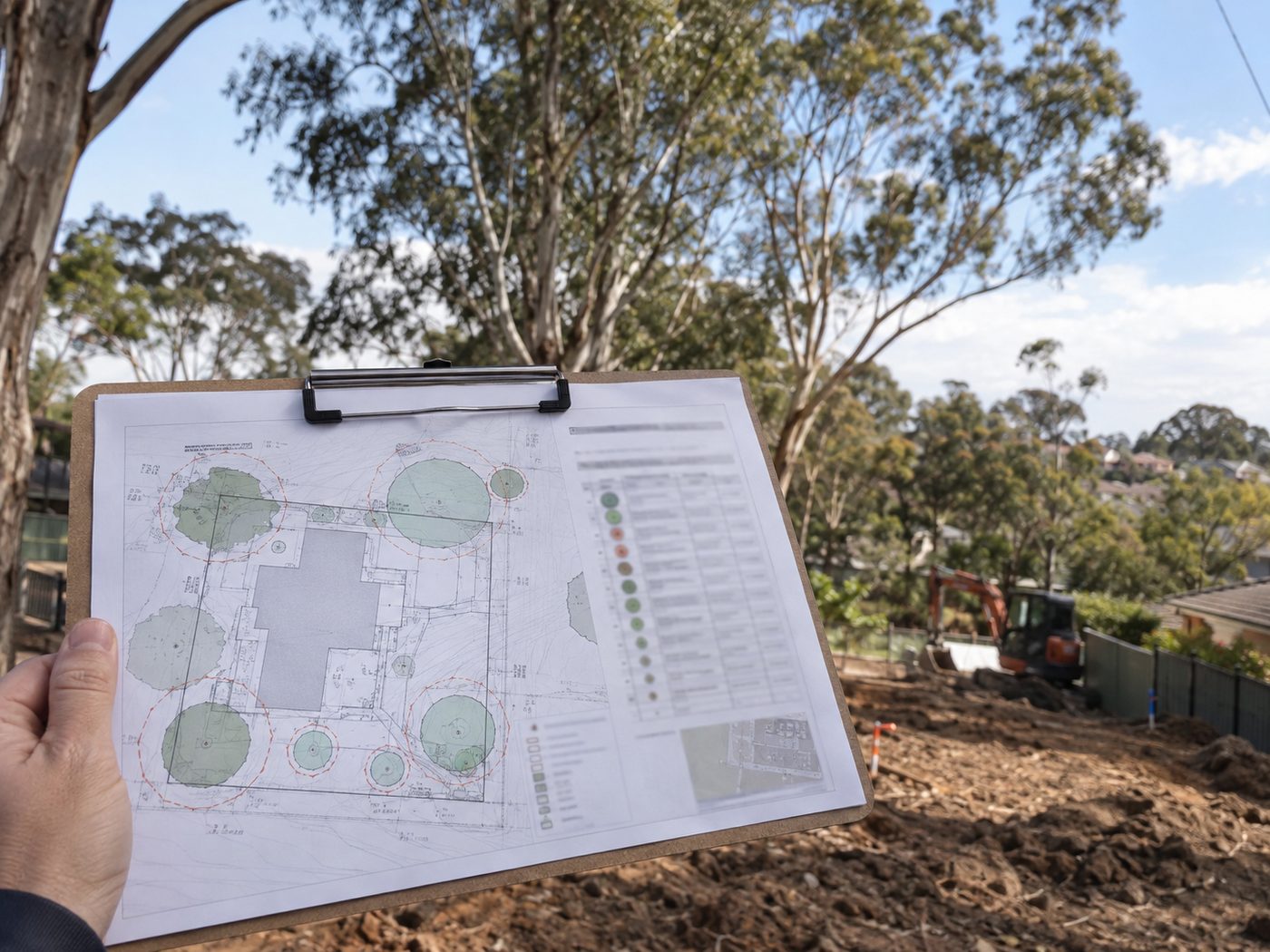
The projects below are drawn from real arboricultural assessments undertaken on properties within the Penrith Local Government Area. They show how tree condition, retention value, Tree Protection Zones, Structural Root Zones and proposed development can produce very different arboricultural outcomes from one property to another.
Some projects involve trees that cannot practicably be retained. Others require trees to be protected despite significant development encroachment. In other cases, the assessment is still underway and no final recommendation has yet been made.
That is why an Arborist Report should start with the evidence, not a predetermined outcome.
Request a free quoteAQF Level 5 Consulting ArboristsQTRA & TRAQ Qualified32+ Years’ Arboricultural Experience
Real Penrith Arboricultural Projects
Penrith
Mixed-use development where three trees had 100 per cent root-zone encroachment and retention was considered unfeasible.
South Penrith
Four-tree residential assessment resulting in both retention and removal recommendations.
Penrith
Larger residential assessment involving 14 trees with different retention values.
Penrith
Six-tree assessment involving established trees, a neighbouring tree and two Grey Box specimens, with final development recommendations still to be completed.
Case Study 1: Mixed-Use Development, Penrith
Arboricultural Impact Assessment, 100 per cent root-zone encroachment
Site
- Penrith City Council
- MU1 Mixed Use
- Three subject trees assessed
- Proposed development
The assessment considered three trees, a Chinese Hackberry, Chinaberry and Jacaranda, against the proposed development footprint.
Each tree was assessed for dimensions, condition, Safe Useful Life Expectancy, retention value and its relationship with the proposed works. All three were recorded as having moderate retention value.
The development conflict
The critical issue was not simply the species or condition of the trees. It was where the trees and their root zones were located in relation to the proposed building.
The Arboricultural Impact Assessment mapped the trees and their protection areas against the proposed development. All three trees were calculated as having 100 per cent encroachment of their Notional Root Zones.
Arboricultural outcome
The report concluded that Trees 1, 2 and 3 were located wholly within the proposed development footprint.
Retention would require preservation of the root systems necessary to support the trees, but the building footprint would require those root systems to be removed.
The assessment therefore found that there was no practical arboriculturally suitable construction methodology that would enable the trees to be retained, and removal was recommended to facilitate the proposed development.
What this project demonstrates
A development Arborist Report is not simply about whether a tree is healthy.
A tree can have reasonable retention value but still be incompatible with a development where the physical impact on the root system makes viable retention impractical.
The assessment worked through the evidence in this order:
TreeRetention ValueRoot Protection AreaDevelopment FootprintExtent of EncroachmentViabilityRecommendation
Case Study 2: Residential Development, South Penrith
Arboricultural Impact Assessment and tree protection, retention and removal on the same site
Site
- Penrith City Council
- R2 Low Density Residential
- Four trees assessed
- Development plans reviewed
Four trees were assessed as part of the proposed development: a Cabbage Palmetto, a mature deciduous tree, an Orange Jasmine and a Camellia.
The assessment considered tree dimensions, Safe Useful Life Expectancy, retention value and the extent of development encroachment.
Different trees, different outcomes
This project demonstrates why development impact cannot be determined from a simple rule such as more than 20 per cent encroachment means the tree has to go.
Three trees were calculated as having 100 per cent root-zone encroachment and were identified for removal.
But the 12-metre deciduous tree presented a different situation. It had a calculated root protection radius of approximately 9.4 metres and development encroachment of 29.4 per cent, yet the assessment identified the tree for retention.
Why this matters
Under the AS 4970 methodology used in the report, encroachment greater than 20 per cent is classified as major and requires arboricultural assessment rather than an automatic assumption about the tree’s future.
Depending on the circumstances, further assessment, design response and tree protection measures may allow a tree to remain viable. That is the important distinction: major encroachment does not automatically mean removal.
The individual tree, its protection zones, development design and ability to remain viable all need to be considered.
What this project demonstrates
The purpose of an AIA is not to produce the same recommendation for every tree on a development site. It is to determine an appropriate arboricultural response tree by tree.
The assessment worked through the evidence in this order:
4 Trees Assessed3 Identified for Removal1 Retained
Case Study 3: Larger Residential Development, Penrith
Arboricultural Impact Assessment, 14 trees assessed
Site
- Penrith City Council
- R2 Low Density Residential
- 14 subject trees
- Proposed development
Larger development sites can involve very different tree populations and retention priorities.
At this property, 14 trees were assessed as part of the proposed development. The report was prepared to identify trees potentially affected by the works, assess their health and condition, establish retention values and calculate the relevant tree protection areas.
The assessment included a cross-section of species such as Canary Island Palms, Camphor Laurel, Crape Myrtles, Jacaranda, Brush Boxes and Kurrajong.
Rather than treating the 14 trees as having equal arboricultural importance, the tree schedule assigned different retention values across the site.
Why retention value matters
Development arboriculture involves more than counting trees. An assessment needs to help establish which trees warrant greater consideration in the development design and which represent a lower constraint.
Tree dimensions, condition, expected useful life and environmental, physical and amenity considerations can all contribute to retention assessment. At this property, this produced trees with low, moderate and high retention values across the same development site.
Assessment stage
The supplied report contains the tree survey and assessment data, while the Arboricultural Impact Assessment, Tree Protection Plan, recommendations and construction hold points remain to be determined. For that reason, we do not publish a final removal or retention outcome for this project that the report itself does not establish.
What this project demonstrates
This is where an Arboricultural Impact Assessment can become an important part of the design process rather than something prepared after the development layout has already been fixed.
The assessment worked through the evidence in this order:
14 TreesDifferent SpeciesDifferent DimensionsDifferent Retention ValuesDevelopment Assessment
Case Study 4: Residential Property, Penrith
Arboricultural Impact Assessment at assessment stage, mature Grey Box trees and driveway interaction
Site
- Penrith City Council
- R2 Low Density Residential
- Six trees assessed
- Proposed development
Six trees were inspected at this Penrith property using a stage-one Visual Tree Assessment.
The tree schedule included Paperbark, Bottlebrush, Jacaranda, Bracelet Honey-Myrtle and two Grey Box specimens. One of the trees assessed was located on a neighbouring property.
A significant existing tree
The largest tree recorded was a mature Grey Box (Eucalyptus moluccana) approximately 23 metres high, with a 10-metre canopy, an 820mm trunk diameter and a 9.84-metre calculated root protection radius.
The tree schedule also records the observation that the tree is damaging the driveway.
This creates exactly the type of situation where the arboricultural question should be investigated before conclusions are reached. The existence of infrastructure damage by itself does not tell us what the final development or tree-management outcome should be.
The tree’s condition, retention value, root environment, proposed development and potential impact all need to be considered.
No outcome invented
The supplied report for this property is a draft. Its Arboricultural Impact Assessment and Tree Protection Plan, recommendations and construction hold points remain to be determined. Accordingly, we do not claim that the Grey Box was retained or removed.
What this project demonstrates
Good arboricultural assessment separates observations from conclusions. A large tree interacting with infrastructure does not automatically mean removal.
Where the relationship between roots, structures and proposed works requires further evidence, additional investigation may be appropriate before a final recommendation is made.
How a Penrith Development Tree Assessment Is Built
The scope of an Arboricultural Impact Assessment depends on the trees, proposed development and constraints of the individual property. A typical assessment may involve:
Site and planning context
Identifying the property, development proposal and relevant site information.
Visual Tree Assessment
Inspecting subject trees and recording dimensions, health, condition and observable structural characteristics.
Tree Protection Zone and Structural Root Zone assessment
Establishing the areas relevant to tree viability and stability.
Retention assessment
Considering the arboricultural value and expected useful life of individual trees.
Development impact assessment
Overlaying proposed works against the tree protection areas and assessing the significance of encroachment.
Further investigation where necessary
Potentially involving root investigation or other diagnostic work where the initial assessment cannot adequately resolve the issue.
Recommendations and tree protection
Identifying appropriate retention, removal, design or protection measures based on the evidence.
The reports used in these Penrith case studies apply AS 4970, Protection of trees on development sites, when assessing development impacts and tree protection requirements.
Case studies are based on actual arboricultural assessments prepared for properties within the Penrith LGA. Client names, contact details and street addresses are not published. Where a supplied report remains at assessment or draft stage, no final tree outcome has been attributed to that project. Council information last verified: 30 August 2026. Council requirements can change. For a determination specific to your property, confirm current requirements with Penrith City Council or arrange a site assessment.
Why Tree Protection Zones Matter
A building does not need to physically touch a tree trunk to affect the tree.
Excavation, foundations, services, access routes, soil compaction and changes within the root environment can all be relevant when development occurs close to retained trees.
That is why our development assessments consider both the Tree Protection Zone (TPZ) and Structural Root Zone (SRZ). Where significant encroachment is proposed, the question becomes: can the development proceed while maintaining the viability and stability of the tree?
Depending on the site, answering that question may require design modification, construction controls, a Tree Protection Plan, Project Arborist involvement or further investigation of the root environment.
Real Penrith Experience, Not Generic Location Content
These case studies are published to demonstrate the type of arboricultural issues encountered on actual Penrith LGA properties. They include:
The outcome is not predetermined. Our role is to assess the trees and the proposed works, document the arboricultural evidence and provide recommendations appropriate to the individual site.
Need an Arborist Report for Your Penrith Property?
Planning a development, dealing with trees close to proposed building works or trying to determine whether trees can be retained?
Send us the property address, development plans and any relevant Council correspondence. Our AQF Level 5 Consulting Arborists can review the project and determine the arboricultural assessment required.
AQF Level 5 Consulting ArboristsQTRA & TRAQ Qualified32+ Years’ Arboricultural Experience