Penrith Tree Removal & Pruning Guidelines
Council Rules for Prescribed Vegetation, Vegetation Permits, Exemptions and Pruning
Planning to remove or prune a tree on private property in Penrith?
Under Penrith Development Control Plan 2014, Part C2, Vegetation Management, a person must not remove, clear, prune or otherwise cause harm to any tree or other vegetation prescribed by the Plan without an appropriate approval. Council also publishes specific exemptions where certain tree work can proceed without a Vegetation Permit, provided the relevant conditions are met.
This guide explains Penrith’s current tree removal and pruning requirements: which trees are prescribed vegetation, which common permit exemptions apply, what pruning can be done without a permit, and when a Vegetation Permit application is likely to be required.
Removing or clearing vegetation as part of a development? Vegetation removal tied to a Development Application is assessed through the DA itself, not as a standalone Vegetation Permit.
Not sure whether your tree is exempt, needs a Vegetation Permit or needs to be assessed through a Development Application? We can help identify the appropriate pathway before work begins.
Get a free quoteAQF Level 5 Consulting ArboristsTRAQ & QTRA Qualified32+ Years’ Arboricultural ExperienceCouncil-Ready Documentation
Do I Need Council Approval to Remove a Tree in Penrith?
Generally, yes. An appropriate approval is required if the tree or vegetation is prescribed under Part C2 and no applicable exemption applies.
Under DCP Part C2, it is illegal to cut down, clear, ringbark, top, lop, prune, poison or otherwise cause harm to prescribed vegetation without an appropriate approval. This includes removal by any method, ring-barking, topping, lopping, pruning branches greater than 50mm diameter, and damaging roots or the root system.
Before removing a tree on private property, establish:
- whether it meets Council’s prescribed vegetation thresholds
- whether a Vegetation Permit exemption applies
- whether it is on the Significant Trees and Gardens register
- whether native vegetation controls apply
- whether the proposed work is standalone tree management or associated with a Development Application
Private tree removal and development-related tree removal can follow different approval pathways. Do not assume a tree can be removed simply because it is on your property.
What Is Prescribed Vegetation in Penrith?
Under DCP Part C2, prescribed vegetation includes:
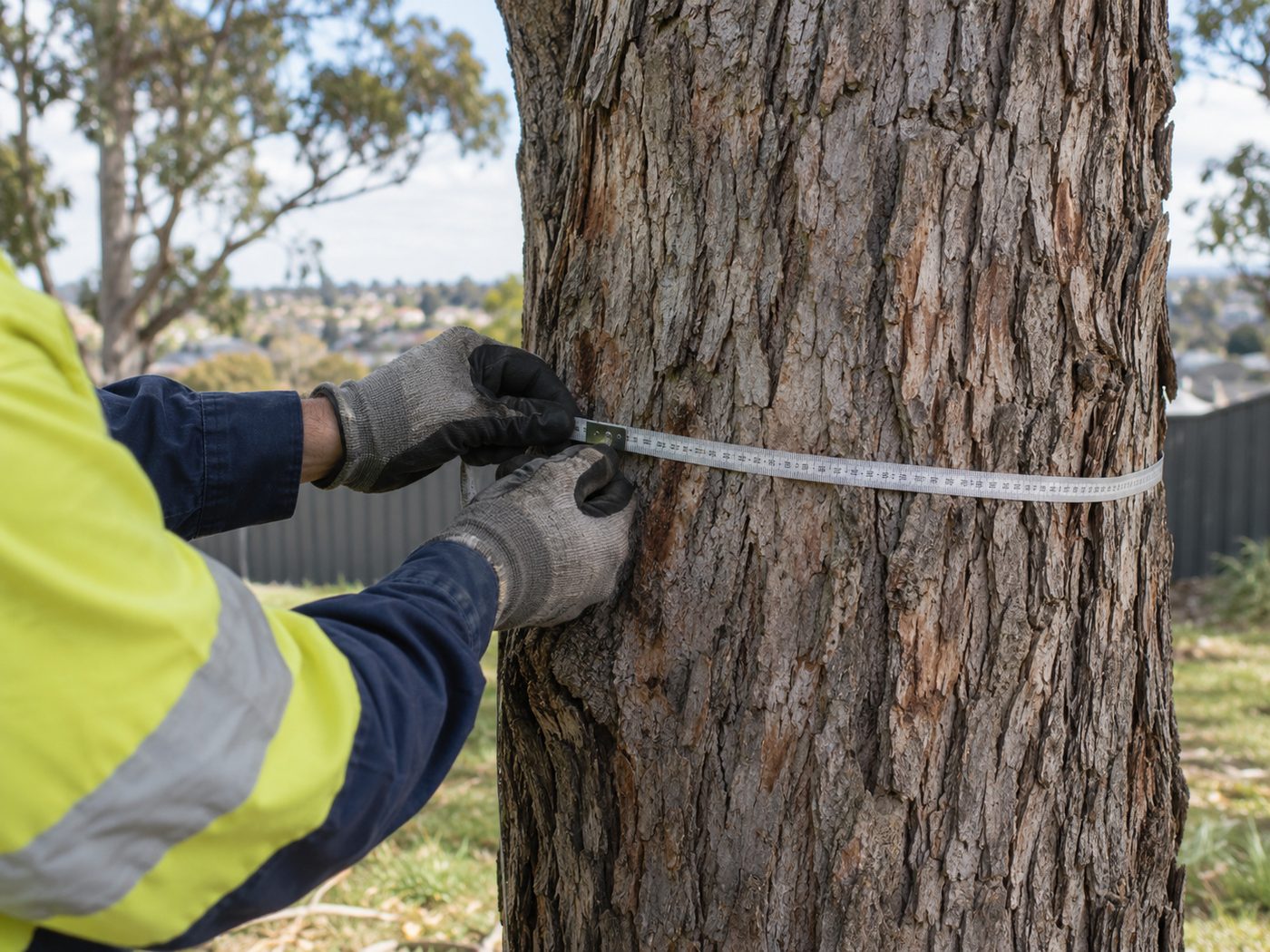
- Any tree or other vegetation, whether native or introduced, having a height of 3.5 metres or more, or a trunk diameter exceeding 100mm, measured 1.4 metres above ground level
- Any native tree, living or dead, or other vegetation on land zoned E2 Environmental Conservation, or identified as natural resources sensitive land
- Any native vegetation community, including remnant native vegetation
- Any tree or vegetation that is, or forms part of, a heritage item or heritage conservation area
- Any tree or vegetation formally recognised as culturally, socially or biologically significant, including the Significant Trees and Gardens register, regardless of size
If your tree meets this definition, the next step is establishing whether an exemption applies, whether the proposed work needs to be considered through a Development Application, or whether a Vegetation Permit is required.
3.5 metres
or more in height
100mm
trunk diameter, measured 1.4 metres above ground level
Any size
where the tree is heritage listed, significant or prescribed native vegetation
Are Any Trees Exempt From Needing a Vegetation Permit in Penrith?
Yes. Council publishes defined exemptions where qualifying work can proceed without a Vegetation Permit. Common exemptions include:
- A tree that is dead and is not habitat for native fauna
- A tree that is an imminent risk or threat to human life or property
- Deadwood that is not habitat for native fauna
- A tree located within 3.0 metres of an external enclosing wall of a dwelling, measured from the centre of the trunk at 1.4 metres above ground level
- An exempt tree species published by Council
- A tree or vegetation that produces edible fruit, excluding Australian natives and ornamental fruit trees
- Minor pruning carried out to AS 4373-2007 within Council’s defined limits
- Branches within 3.0 metres of a dwelling roof, pruned within Council’s defined limits
- A tree causing imminent damage to a perimeter boundary fence on rural land
- Vegetation cleared in accordance with the NSW RFS 10/50 Vegetation Clearing Code of Practice, where the scheme applies
Council’s complete exemption provisions also cover certain authorised bushfire, infrastructure, dam, plantation, weed-management and approved-development works.
Exempt tree species
Council publishes a specific list of exempt tree entries, with conditions applying to individual entries. Being on the list does not necessarily mean a tree can automatically be removed. Height, heritage, significant-tree and other entry-specific conditions can apply.
Penrith Exempt Tree Species List10/50 bushfire clearing
The NSW RFS 10/50 Vegetation Clearing Scheme is a separate statutory pathway. Eligibility is parcel-specific, and tree clearing within 10 metres is different from vegetation clearing within 50 metres.
Penrith 10/50 Bushfire Tree Clearing GuideCouncil information last verified: 30 August 2026. Council requirements can change. This page provides general guidance. For a determination specific to your property, confirm the current requirements with Penrith City Council or arrange an appropriate site assessment.
Before Relying on an Exemption
Council’s advisory notes include several important requirements:
- Property owner consent is required before carrying out exempt work
- For dead-tree, dangerous-tree, deadwood and rural-fence exemptions, Council advises obtaining a report from a suitably qualified arborist or other suitable evidence confirming that the relevant criteria are met before work is carried out
- Property owners must be able to demonstrate that the exemption criteria were satisfied if Council requests evidence
- Where there is uncertainty, Council recommends confirming the position before proceeding
A tree that is almost within 3 metres, appears dead or seems dangerous does not necessarily satisfy Council’s exemption criteria.
Where an exemption depends on a precise measurement, tree condition or other evidence, confirming the criteria before work begins can avoid relying on an exemption that does not actually apply.
What Pruning Can Be Done Without a Vegetation Permit?
A Vegetation Permit is not required to prune a tree in accordance with AS 4373-2007 where one of Council’s relevant exemption conditions applies.
| Situation | Condition |
|---|---|
| General minor pruning | Branches no greater than 50mm diameter; tree shape and structure not significantly modified |
| Branches within 3.0 metres of a dwelling roof | Final cut back to nearest branch junction or collar; largest cut no greater than 150mm diameter |
| Branches within 2.0 metres of ground level, on a tree greater than 6.0 metres high | Final cut back to nearest branch junction or collar; largest cut no greater than 150mm diameter |
All pruning work should comply with AS 4373-2007, and property owners should be able to demonstrate that the relevant exemption condition was satisfied if requested by Council.
Native Vegetation Is Different
If the proposed clearing involves native vegetation, including native trees, bushland, grasses or ground covers, a different approval pathway can apply.
Where clearing of native vegetation is not associated with a Development Application and the area of clearing exceeds the relevant threshold below, or the land is identified on the Biodiversity Values Map, approval is required from the State Government’s Native Vegetation Panel, rather than Council.
| Minimum lot size | Clearing threshold requiring Native Vegetation Panel approval |
|---|---|
| Less than 1 ha | 0.25 ha or more |
| 1 ha to less than 40 ha | 0.5 ha or more |
| 40 ha to less than 1,000 ha | 1 ha or more |
| 1,000 ha or more | 2 ha or more |
Where clearing does not exceed the relevant threshold and is not linked to a Development Application, it is assessed through Council’s standard Vegetation Permit pathway.
If it is unclear whether vegetation on the property falls within the ordinary tree controls or broader native vegetation provisions, establish that before clearing begins.
What If the Tree Is Being Removed for a Development?
Where tree or vegetation removal is proposed to facilitate development, the impacts and proposed removal must be assessed as part of the Development Application rather than relying on a separate Vegetation Permit pathway.
This is where an Arboricultural Impact Assessment (AIA) may be required to identify the trees affected by the proposal, assess development impacts, establish Tree Protection Zones and Structural Root Zones, and provide recommendations for retention, removal and protection.
A Vegetation Permit will generally not be issued to facilitate Complying Development. If a Complying Development proposal cannot satisfy the applicable tree and vegetation controls, a Development Application may be required.
What can happen if you get it wrong?
Unauthorised removal, clearing, pruning or damage to prescribed vegetation may result in Council enforcement action, including penalty notices or prosecution.
Obtaining arboricultural advice does not itself replace the need to establish that the proposed work meets a Council exemption or has the required approval.
Why an Assessment Comes Before the Decision
Council’s criteria depend on measurable and identifiable facts.
Trunk diameter is measured at a specified height. Species identification can determine whether an exemption applies. Distance to a dwelling is measured from the trunk rather than the canopy edge. A dangerous-tree exemption depends on the tree actually meeting Council’s relevant risk criteria.
An arboricultural assessment is therefore not simply paperwork prepared after someone has already decided to remove a tree.
Done properly, it helps establish whether the proposed work appears to satisfy an exemption, whether further evidence is appropriate, or whether a Vegetation Permit application is likely to be required.
How We Assess Your Tree
On-site inspection
An AQF Level 5 Consulting Arborist assesses the tree, including relevant measurements, species identification, condition and site circumstances.
Exemption check
The proposed work is considered against Council’s current published exemption criteria, including relevant tree dimensions and distances to structures.
Appropriate pathway
We identify whether the work appears exempt, whether a Vegetation Permit is likely to be required, or whether another pathway such as development assessment or 10/50 needs to be considered.
Documentation where appropriate
Where written evidence is appropriate, particularly for dangerous-tree or dead-tree exemptions, documentation can record the assessment and relevant arboricultural findings.
Vegetation Permit support
Where professional arboricultural evidence is required to support a Vegetation Permit application, we can prepare the appropriate report.
How Do I Apply to Penrith City Council?
Where a tree does not meet an exemption, an Application to Remove or Prune Trees can be submitted to Council.
Native vegetation clearing not linked to a Development Application and exceeding the applicable threshold is instead directed to the Native Vegetation Panel.
If you already have correspondence from Council, send it together with photographs of the tree and property details. We can help identify the appropriate arboricultural assessment or report.
Request a free quoteFrequently Asked Questions
The permit questions that come up most often before removal or pruning.
Do I need a permit for a small tree in my backyard?
Not necessarily.
Many smaller trees fall outside Council’s prescribed vegetation definition of 3.5 metres in height or more than 100mm trunk diameter measured at 1.4 metres. However, other controls can still apply, including the Significant Trees and Gardens register and native vegetation provisions.
Is an Arborist Report required for every Penrith tree removal?
No.
Not every tree removal requires an Arborist Report. Whether professional arboricultural evidence is appropriate depends on the tree, proposed work and approval or exemption pathway. Where evidence is needed to support a Vegetation Permit application or demonstrate that an exemption applies, an arboricultural assessment can provide that evidence.
Can I remove a tree because I think it is dangerous?
Not simply because it appears dangerous.
The relevant exemption depends on the tree meeting Council’s criteria for an imminent risk or threat to human life or property. Council advises obtaining evidence, typically from a suitably qualified arborist, before relying on the exemption.
What if the tree is dead?
A dead tree may be exempt.
However, the exemption does not apply where the tree provides habitat for native fauna. That condition should be checked before removal.
What if my tree is on Council’s exempt species list?
The species exemption may apply, but individual entries can carry conditions.
These can relate to height, heritage or other matters.
Does the NSW RFS 10/50 Scheme replace Council’s normal tree rules?
Only where the property and proposed clearing genuinely qualify.
Eligibility is parcel-specific and other restrictions can still apply.
What is the difference between this guide and the Development Tree Compliance Guide?
This page covers standalone removal and pruning; the Compliance Guide covers development-related trees.
This page primarily covers standalone tree removal and pruning under Penrith’s Vegetation Permit framework. The Penrith Development Tree Compliance Guide covers trees and vegetation affected by Development Applications, including Arboricultural Impact Assessments and development-related tree protection requirements.
Need Advice Before You Cut?
Not every tree needs a Vegetation Permit, and not every tree needs an Arborist Report. The important step is establishing the correct pathway before work begins.
Penrith Tree Permit Services can assess the tree against the relevant Council criteria and prepare professional arboricultural evidence where it is required for a Vegetation Permit, exemption or development matter.
AQF Level 5 Consulting ArboristsTRAQ & QTRA Qualified32+ Years’ Arboricultural Experience