Do I Need a Tree Report for My Penrith Development Application?
A Plain-Language Guide to Trees, Development Applications and Penrith City Council’s Requirements
Planning a new home, extension, subdivision or other development in Penrith, and there are trees on or near the site?
If your project could affect an existing tree, tree impacts may need to be addressed as part of your Development Application. The level of information Council requires depends on the trees involved, the scale of the development and how the proposed works interact with them.
This page explains that requirement in plain terms: when a tree report is needed, what it has to contain, and how it fits into the rest of your DA. If you are already working with plans, an architect, or a full site layout and need the technical detail, including Tree Protection Zone and Structural Root Zone calculations, the Arboricultural Impact Assessment process and construction-stage compliance, that level of detail lives on our Development Arborist Reports page.
Removing or pruning a tree on private property, unrelated to a development? That is a different pathway. See our Tree Removal & Pruning Guidelines instead.
Request a free quoteAQF Level 5 Consulting Arborists32+ Years’ Arboricultural ExperienceCouncil-Ready Documentation
When Does Penrith Council Require a Tree Report for a DA?
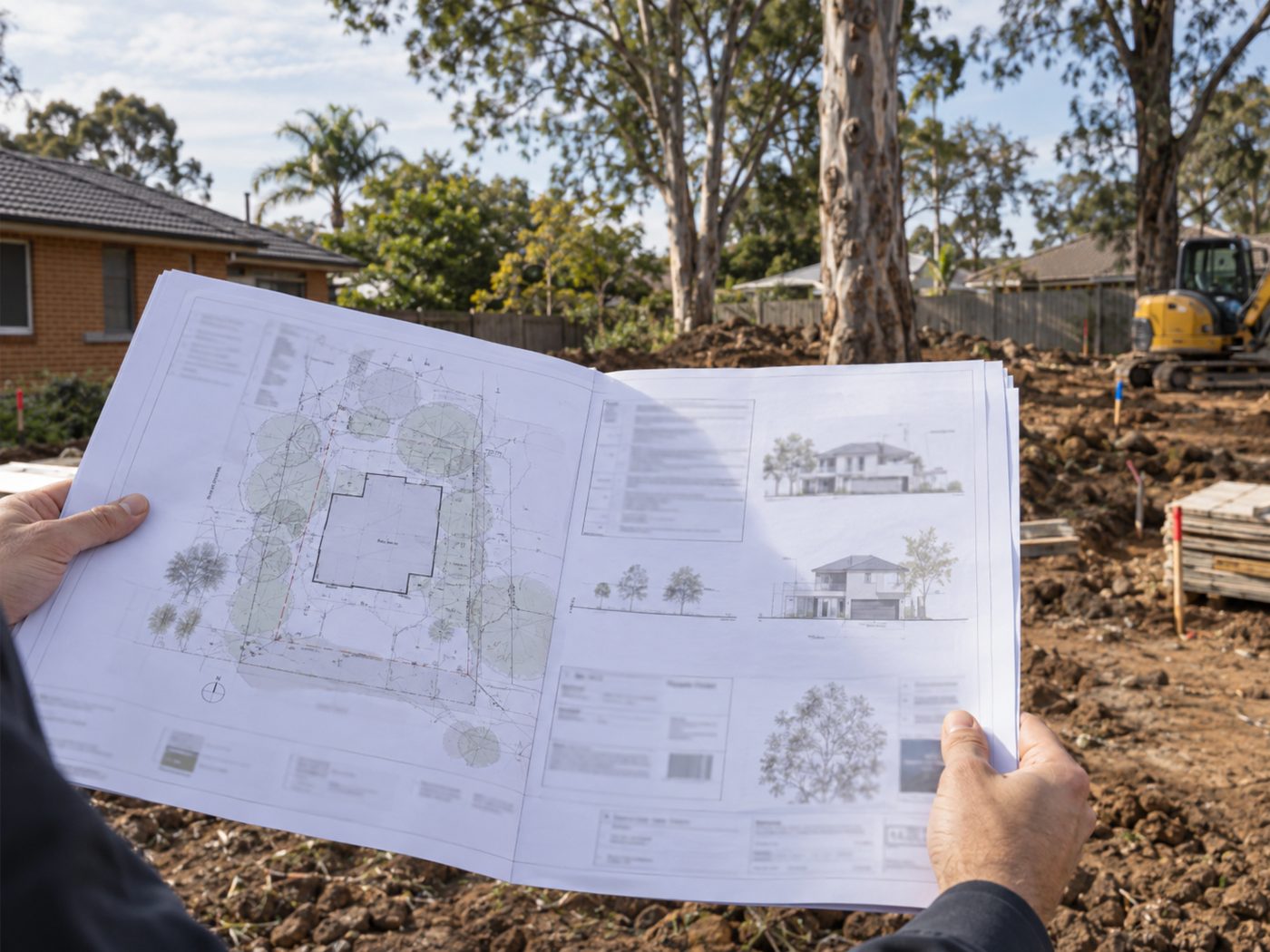
Under Penrith Development Control Plan 2014, Part C2, Vegetation Management, works that would ringbark, cut down, top, lop, remove, injure or destroy a tree or other vegetation must be assessed for their impact before they proceed. Where that work is proposed as part of a development, rather than as standalone private tree removal, the assessment happens through the Development Application itself.
A tree report is likely to be needed where your project involves:
- A tree located on the site, or on an adjoining property, that is close enough to the proposed works to be affected
- Construction such as footings, driveways, pools, retaining walls or services that comes within or near a tree’s Tree Protection Zone or Structural Root Zone
- Any tree proposed for removal to make way for the development
- A tree Council has specifically asked about, or flagged in a Request for Further Information
- Land affected by heritage controls, environmentally sensitive land, or the Biodiversity Values Map, where vegetation is part of what is being assessed
Council’s own guidance is direct on this point: applicants are advised to consult with Council’s Development Services Unit or Tree Management Officer about the correct form of application and the level of information required, rather than assume.
What Actually Gets Submitted, and Why It Depends on Your Project
Not every development needs the same level of tree documentation. Penrith’s DA submission requirements, Appendix F3 of the DCP, set out a minor development and major development distinction, and what is required scales with that distinction, the land use, and the site’s specific features.
At the most basic level, if works to trees or vegetation form part of your application, Council will expect at least one of two things.
A Tree Survey and Assessment Report
The minimum level of documentation for any application involving tree work. This must address the location and type of the trees or vegetation, the proposed works and the reasons for them, the tree’s health, structural condition and root zone condition, its aesthetic, scientific or historic importance, the impact of the proposed work on its appearance, health, stability and the surrounding area’s amenity including streetscape, whether pruning would be a more practicable alternative to removal, the risk of personal injury or property or service damage, the extent of other trees and vegetation on the property, and whether the tree provides habitat, food or shelter for fauna.
An Arboricultural Survey Report
Also called an Arborist Report. Required for larger or more significant trees, and for existing trees or shrubs taller than 5 metres specifically. This is a more detailed technical document, prepared by a qualified consulting arborist, and covers matters like Tree Protection Zone calculations, species and dimensions, health and condition, and the trees on adjoining properties within 3 metres of the boundary.
See what an Arboricultural Survey Report containsImportant: Penrith has different tree thresholds for different purposes
The 5-metre threshold above relates specifically to Arboricultural Survey Report requirements for Development Applications under Appendix F3. It should not be confused with the separate 3.5 metre height and 100mm trunk diameter criteria used to determine whether standalone tree removal or pruning, unrelated to a development, requires a Vegetation Permit. If your question is about removing or pruning a tree without a development involved, see our Tree Removal & Pruning Guidelines instead.
Where trees are being retained as part of the development, Council also generally requires a Tree Management Plan, in place before any site works begin, including demolition or machinery entering the site.
How Council Decides Whether a Tree Can Be Removed
Penrith City Council generally encourages retention of trees on development sites, and encourages designs that minimise the need for removal while protecting the trees that stay. That is the starting position, not an assumption that removal will be approved because a tree is inconvenient for a design.
Where removal is proposed, Council will consider whether the applicant can demonstrate one or more of the following:
- The development cannot reasonably be modified to retain the tree without becoming economically unviable
- The tree is of a size and scale that would be incompatible with the development even if retained
- The tree’s health warrants removal because it poses a hazard or threat
- The tree’s safe useful life expectancy is minimal
- The tree makes minimal contribution to the streetscape
- The tree makes minimal contribution to the landscape amenity of the locality or neighbouring properties
Council also weighs the tree’s contribution to the visual landscape it sits within, including the streetscape and any distant views, and whether the development could instead be modified to retain it. For significant trees being retained, Council can require a formal valuation using the Thyer Method, submitted alongside the Arboricultural Survey Report.
This is why a tree being in the way of a planned extension is not, by itself, a basis for approval. The case for removal needs to be made against these specific considerations.
Council information last verified: 30 August 2026. Council requirements can change and depend on your specific site and proposal. This page provides general guidance current as of the date above. For a determination specific to your property, confirm current requirements with Penrith City Council’s Development Services Unit or Tree Management Officer, or arrange a site assessment.
Trees on Neighbouring Properties Matter Too
Your Arboricultural Survey Report is not limited to trees actually on your block.
It needs to identify all trees on adjoining properties within 3 metres of your development’s boundary, and where your proposed works could significantly affect the future health of a large or significant tree further away than 3 metres, that tree’s existence and appropriate management still needs to be noted and addressed.
In practice, this means a mature tree on your neighbour’s side of the fence can still shape what your development can do close to that boundary, even though you do not own it.
3 metres
from the development boundary is the distance within which neighbouring trees must be identified in an Arboricultural Survey Report.
5 metres
tree or shrub height is the trigger for an Arboricultural Survey Report under Appendix F3.
Where Trees Sit in the Bigger DA Picture
A tree report is rarely the only supporting document your DA needs. It is typically one part of a package that can include a Landscape Plan, a Statement of Environmental Effects, an Erosion and Sediment Control Plan, and others, depending on your project type.
Penrith’s DA Submission Requirements set out a matrix of what is needed for different development types, including a new dwelling, a subdivision, a swimming pool and a commercial building, and a Landscape Plan noting existing significant vegetation is a common thread across most of them.
If native vegetation, bushland, or a heritage-listed tree is involved, a Flora and Fauna Assessment Report or a Heritage Impact Statement may also be triggered. These sit alongside, not instead of, the tree-specific documentation above.
What Happens If You Skip This Step
Lodging a DA without addressing tree impacts where they are clearly relevant tends to produce one of a few outcomes:
- Your application sits with Council longer than it needs to
- Council issues a Request for Further Information, pausing the clock until it is answered
- Your design may need to be reworked around a tree issue that could have been identified earlier
- In some cases, the application can be refused
Getting the arboricultural position sorted before lodgement, ideally before your architect or designer has locked in the final layout, is almost always faster and cheaper than resolving it after Council raises it.
When to bring in an arborist
Ideally, before your design is finalised.
Early assessment can identify which trees genuinely constrain the site, where root zones are likely to conflict with footings or driveways, and where a small design shift avoids a much larger problem later.
Once plans are locked in and lodged, the same issues still have to be resolved, just with less flexibility and, often, more delay.
Request a free quoteFrequently Asked Questions
What Council requires from a Development Application involving trees.
Do I need a tree report for every Penrith DA?
No.
Only where the proposed works could affect an existing tree, on your site, or close enough on a neighbouring property to be relevant. Many straightforward developments on cleared or lightly vegetated sites will not trigger this requirement.
What is the difference between a Tree Survey and Assessment Report and an Arboricultural Survey Report?
The Tree Survey and Assessment Report is the minimum; the Arboricultural Survey Report is more detailed.
The latter is generally required for larger or significant trees and for existing trees or shrubs over 5 metres tall, and includes matters such as Tree Protection Zone calculations.
Can I just remove the tree before lodging my DA to avoid the issue?
No, not where the removal is intended to facilitate the proposed development.
Council expects that removal to be assessed as part of the DA itself rather than carried out separately beforehand.
Does a tree on my neighbour’s property affect my DA?
It can.
Trees on adjoining land within 3 metres of your development boundary need to be identified in your Arboricultural Survey Report, and even trees further away can be relevant if your works would significantly affect their future health.
Will Council make me keep every tree on the site?
No.
Council’s starting position favours retention, but removal can be considered against specific criteria including economic viability, incompatibility with the development, health and safety, limited useful life, or minimal streetscape or amenity contribution.
What if my project is small, such as an extension or a garage?
It can still require tree documentation.
This applies if a relevant tree is close enough to be affected. The requirement depends on the actual site and proposed works, not just the size of the building project.
Planning a Development Near Trees in Penrith?
Whether you are at concept design, about to lodge, or responding to a Council Request for Further Information, establishing the tree position early avoids redesign and delay later.
Send us your plans, site photos of any trees on or near the property, and any Council correspondence you have already received. Our AQF Level 5 Consulting Arborists can identify what is actually required for your project.
AQF Level 5 Consulting Arborists32+ Years’ Arboricultural Experience