Tree Health & Safety Assessments Penrith
AQF Level 5 Tree Reports, Tree Risk Assessment and Structural Assessment
Concerned that a tree may be dangerous, unhealthy or structurally compromised?
Penrith Tree Permit Services provides Tree Health & Safety Assessments, Tree Reports and AQF Level 5 Arborist Reports for trees where health, structural condition or risk needs professional assessment.
A tree may look healthy while containing significant structural defects. Conversely, a tree that concerns a property owner does not necessarily require removal.
The purpose of the assessment is to establish what is actually happening with the tree, what level of risk exists and what management response is appropriate.
If you have simply been told you need a tree report because of concerns about a tree’s condition or safety, send us photographs and the property details. We can identify the appropriate level of assessment.
AssessInvestigate Where NecessaryDocument the EvidenceRecommend Management
AQF Level 5 Consulting ArboristsQTRA & TRAQ QualifiedAdvanced Diagnostics32+ Years’ Experience
Do I Need a Tree Report for a Dangerous or Unhealthy Tree?
Not every concerning tree requires an extensive Arborist Report.
A Tree Report or Arborist Report may be appropriate where you need professional evidence about:
The assessment should match the actual problem. Where visual assessment provides sufficient information, further testing may not be necessary. Where important uncertainty remains, additional investigation can provide stronger evidence.
Get a free quoteWhat Does a Tree Health & Safety Report Assess?
A professional tree assessment considers the health, structural condition, defects, surrounding targets and appropriate management of the tree, not simply whether it looks dangerous.
Depending on the circumstances, assessment can consider:
Tree health
Canopy condition, vitality, decline, foliage, dieback and other indicators of physiological condition.
Structural condition
The trunk, major unions, scaffold branches, root flare and other structurally important parts of the tree can be assessed for visible defects or evidence of failure.
Decay and cavities
Decay, cavities and other internal defects can affect the amount and distribution of sound wood within a tree.
Root and stability concerns
Root damage, restricted rooting environments, excavation, soil changes or other site conditions may affect tree stability or long-term viability.
Targets and consequences
Tree risk depends not only on the tree but also on what could be affected if a tree or branch failed.
Management options
The appropriate response may involve retention, monitoring, pruning, further investigation or removal, depending on the evidence.
Tree Risk Assessment Is More Than Looking for Defects
A defect does not automatically make a tree dangerous.
Professional tree-risk assessment considers the relationship between the tree, the defect, likelihood of failure, likelihood of impact and potential consequences.
Our Consulting Arborists hold QTRA and TRAQ qualifications, providing recognised tree-risk assessment methodologies where formal risk assessment is appropriate.
The objective is not to find reasons to remove trees. It is to provide an evidence-based assessment that helps determine whether the tree can reasonably be retained and managed or whether intervention is warranted.
When Visual Assessment Is Not Enough
Most assessments begin with a visual inspection. Sometimes that is sufficient. In other cases, a significant question remains that cannot be reliably answered from ground-level observation alone. This is where specialist investigation can materially improve the evidence.
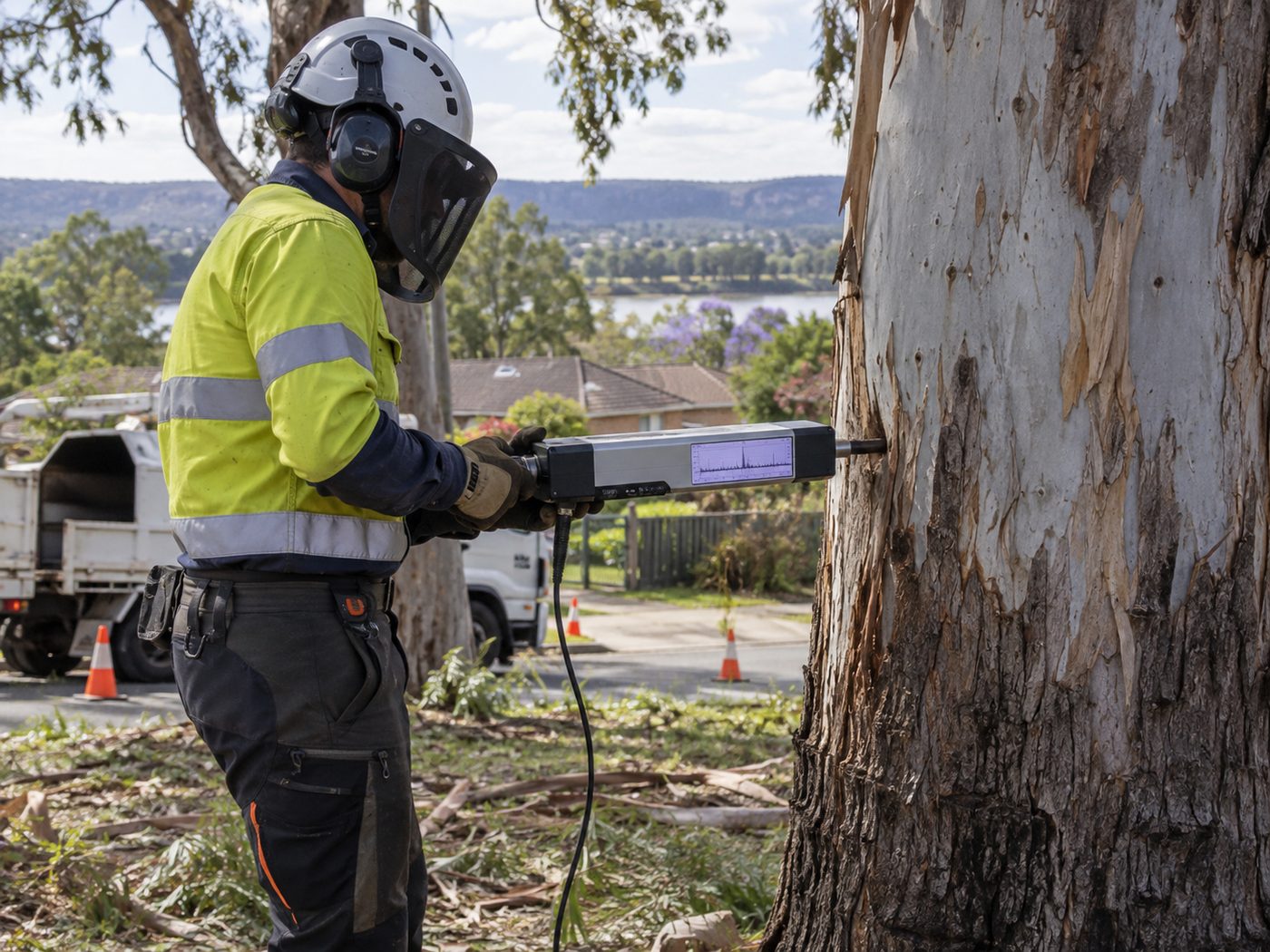
Resistograph investigation
Where internal wood condition or suspected decay requires further investigation, Resistograph testing can provide additional information about resistance through the tested section of wood.
It can assist the arborist in investigating suspected internal defects rather than relying solely on external appearance.
Root investigation and mapping
Where tree roots, excavation, structural damage or stability are in question, non-destructive root investigation can help establish root location, diameter and depth.
Tree Root Investigation & Mapping PenrithElevated tree inspection
Some important defects cannot be adequately assessed from ground level. Where appropriate, an elevated inspection can allow closer examination of unions, cavities, cracks, decay or other defects within the canopy.
The investigation method should follow the question, not the other way around.
What Does an AQF Level 5 Arborist Report Provide?
An AQF Level 5 Arborist Report provides an evidence-based record of the tree assessment where written documentation is required.
Depending on the matter, this can include:
The report should explain why a recommendation has been made, rather than simply state that a tree should be retained or removed.
Council information last verified: 30 August 2026. Council requirements can change. This page provides general guidance current as of the date above. For a determination specific to your property, confirm current requirements with Penrith City Council or arrange a site assessment.
Does a Dangerous Tree Automatically Need Removal?
No. The presence of a defect does not automatically mean complete removal is the appropriate response.
Depending on the tree and circumstances, management may involve:
RetainMonitorPruneFurther InvestigateRemove
For example, a tree may contain a defect that can reasonably be managed through appropriate pruning or monitoring. Alternatively, investigation may identify a structural condition or level of risk that makes removal appropriate.
The recommendation should follow the evidence.
Tree Reports for Penrith Council
A Tree Health & Safety Report may also be required where arboricultural evidence is being provided to Penrith City Council.
This can occur where tree condition, structural defects or risk are relevant to proposed tree removal, pruning or an exemption pathway.
Where an imminent-risk exemption is being relied upon, Penrith Council’s guidance notes a preference for assessment by an AQF Level 5 Consulting Arborist.
The assessment should clearly document the conditions supporting the arboricultural conclusion.
Health & Safety Assessment or Tree Removal Report?
The two can overlap, but the purpose is different.
A Tree Health & Safety Assessment begins with the question: what is the condition and risk associated with this tree?
A Tree Removal Report begins with a proposed management outcome: is there sufficient arboricultural evidence to support removal?
Where the tree’s condition is genuinely uncertain, assessment should come before deciding the outcome. This distinction is valuable because it demonstrates that our recommendations are based on the tree rather than starting with a predetermined removal recommendation.
What If Tree Roots Are the Concern?
Where the concern involves tree roots and buildings, driveways, retaining walls, services or proposed excavation, visual assessment alone may not establish the relationship.
Non-destructive root investigation can help identify:
What If the Tree Is Part of a Development?
Tree assessment associated with development follows a different pathway.
Where proposed construction may affect trees, an Arboricultural Impact Assessment (AIA) may need to consider tree retention, Tree Protection Zones, Structural Root Zones and development impacts.
A health or structural assessment may contribute to that process, but it does not replace a development-focused AIA where one is required.
Emergency tree risk
Some situations require immediate attention rather than a standard assessment appointment. Examples can include:
Where there is an immediate danger, keep people away from the affected area and seek appropriate emergency assistance.
Tree Health & Safety Assessments Throughout Penrith
We provide Tree Reports, Arborist Reports and Tree Health & Safety Assessments throughout the Penrith LGA.
North Ward
Agnes Banks, Berkshire Park, Cambridge Gardens, Cambridge Park, Castlereagh, Cranebrook, Emu Heights, Emu Plains, Jordan Springs, Kingswood, Llandilo, Londonderry, Penrith, Werrington, Werrington County and Werrington Downs.
The North Ward includes established residential areas, newer development and larger rural-residential properties where mature trees, large trees and changing site conditions can require professional assessment.
North Ward Arborist ReportsSouth Ward
Badgerys Creek, Emu Plains, Glenmore Park, Jamisontown, Kingswood, Leonay, Luddenham, Mulgoa, Orchard Hills, Penrith, Regentville, South Penrith and Wallacia.
The South Ward includes established residential areas together with larger rural and semi-rural properties and areas influenced by the Nepean River, escarpment and bushland environments. Tree assessments can involve mature trees, storm damage, structural condition, tree risk and trees within more complex environmental settings.
South Ward Arborist ReportsEast Ward
Caddens, Claremont Meadows, Colyton, Erskine Park, Kemps Creek, Kingswood, Mount Vernon, North St Marys, Orchard Hills, Oxley Park, St Clair and St Marys.
The East Ward includes established residential areas, redevelopment, newer suburbs and industrial and rural-residential properties. Common assessment issues can involve mature trees near homes and boundaries, root conflicts, changing site conditions and trees affected by redevelopment.
East Ward Arborist ReportsRelevant Penrith Tree Health & Risk Case Studies
Relevant Penrith case studies can demonstrate situations involving:
Why Choose Penrith Tree Permit Services?
AQF Level 5 Consulting Arborists
Professional assessment and evidence-based Arborist Reports.
QTRA & TRAQ Qualified
Recognised tree-risk assessment methodologies where appropriate.
32+ Years’ Arboricultural Experience
Practical experience assessing tree health, structure, defects and management options.
Advanced Diagnostics
Resistograph and non-destructive root investigation available where visual assessment does not answer the arboricultural question.
Ground and Elevated Assessment
Closer inspection of canopy defects can be undertaken where appropriate rather than relying solely on observations from ground level.
Evidence Before Recommendation
The objective is to determine the appropriate management response, not automatically recommend removal.
Council-Ready Reporting
AQF Level 5 Arborist Reports where professional evidence is required for Penrith Council.
Frequently Asked Questions
How a dangerous or declining tree is assessed, and what the report can support.
I have been told I need a tree report because my tree may be dangerous. Can you help?
Yes.
Our AQF Level 5 Consulting Arborists can assess the tree’s health, structural condition, defects and risk and prepare a Tree Report or Arborist Report where written evidence is required.
Is a Tree Health & Safety Report an Arborist Report?
Yes.
Tree report is commonly used as a general term. A professional Tree Health & Safety Report is an Arborist Report prepared following arboricultural assessment of the tree and the relevant concerns.
Does a dangerous-looking tree need to be removed?
Not necessarily.
The appropriate response may be retention, monitoring, pruning, further investigation or removal depending on the tree and the evidence identified during assessment.
Can you test for internal decay?
Yes, where further investigation is appropriate.
Resistograph testing can provide additional information about resistance through the tested section of wood and assist with investigation of suspected internal defects.
Can you assess defects high in the tree?
Yes, where an elevated inspection is appropriate.
A significant defect that cannot be adequately assessed from ground level may require closer examination within the canopy.
Can you investigate tree roots?
Yes.
Non-destructive root investigation can help identify root location, diameter and depth where root-related questions need further evidence.
Can the report be used for Penrith Council?
Yes, where Council requires arboricultural evidence.
An AQF Level 5 Arborist Report can document the assessment, relevant findings and recommendations for Council consideration.
What happens if the assessment shows the tree should be removed?
The next step is establishing the applicable Council approval or exemption pathway.
This is confirmed before removal proceeds.
Concerned About a Tree in Penrith?
Whether you have been told you need a tree report, are concerned about a dangerous tree, need an AQF Level 5 Arborist Report or require further investigation of a structural defect, we can establish the appropriate level of assessment.
Send us photographs of the tree, the property address and any Council correspondence.
AQF Level 5 Consulting ArboristsQTRA & TRAQ QualifiedAdvanced Diagnostics32+ Years’ Experience